Case study · Founded & designed · 2023 — present

KDK: designing the mentorship I couldn't find.

The short version

When I started out in design, I went looking for mentorship — someone a few steps ahead who'd tell me the truth about the work — and it didn't exist in any form I could reach. Formal courses taught tools. What I needed was honest conversation.

So I built it. Kenyan Design Konversations is a podcast and community that grew from one mic in my house to 3,400+ designers across Africa and 150+ episodes — and I treat it the way I treat any product: researched, designed, systemised, iterated, and occasionally taken apart when something fails.

This is the project that proves how I think, because there was no client, no brief, and no salary. Just a gap I lived inside, and the decision to close it.

Role

Founder — strategy, brand, content systems, community design, host

Team

Three of us — I'm the founder; two pillars run the ground game

Format

Podcast + WhatsApp community + LinkedIn + YouTube + live events

Running since

Late 2023 — including one full stop, story below

The problem

Where do African designers go to grow?

The gap wasn't information — the internet is drowning in design content. The gap was honest, reachable conversation: people a few steps ahead, in your context, telling the truth about rates, rejection, bad clients, self-teaching, and what the work actually feels like. Mentorship as it existed was either formal and foreign, or informal and locked inside networks I wasn't in.

I wasn't the only one outside those networks. That hunch — that my problem was a market's problem — was the founding insight, and everything since has been testing it.

The first design decision

Episode one was just me. And the grasshoppers.

The first episode had no guest. It was me, alone with a mic, introducing myself — and telling people things I'd never told anyone. Including that I have eaten grasshoppers, that I liked them, and that I would absolutely do it again.

I didn't plan to open with grasshoppers — it just came out, and I let it stay. Because I understand that vulnerability, at some point, makes you human. A community built on honest conversation has to hear what honesty sounds like before anyone else will risk it, and the founder goes first. Episode one was the prototype for the whole product.

Episode two brought the first guest, Stephanie Kabi, and the format found its shape: candid conversations with designers further along, recorded so the person who couldn't find mentorship could at least overhear it.
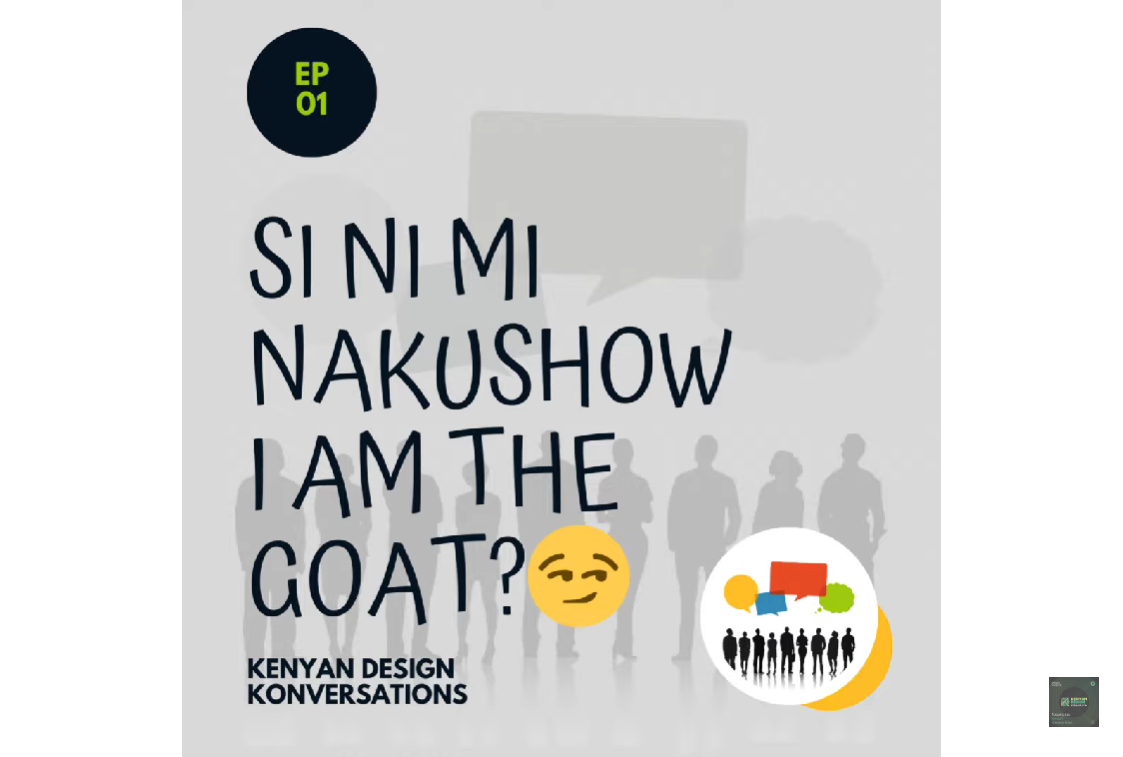
KDK Episode One — original cover art
The failure — the real one

In mid-2024, KDK stopped. Completely.

We halted production — not a break, a full stop. We had good people and real momentum, and none of it mattered, because we had no structure and no roadmap. Everything ran on my energy, and when my energy ran out, so did KDK.

Worse: when we resumed in 2025, I still hadn't diagnosed it. I treated the collapse as a stamina problem — rest, come back, push harder. So we came back exactly the way we'd fallen: structureless. It took most of that year winding down for the truth to land. Even the best team gets nowhere without structure. The problem was never talent or commitment. It was that there was nothing for talent and commitment to run on.

The same disease, smaller scale

The book club told the identical story in miniature — twice. A synchronous virtual format, low turnout, hours I didn't have. It died. I relaunched it the same way. It died again. Only on the second death did I interrogate the assumption instead of the effort: busy designers across time zones won't attend scheduled calls for a book. The value was real; the delivery was wrong. The redesign is asynchronous and WhatsApp-native — daily drips of a book's ideas, in the channel people already live in. First book: Don't Make Me Think. Fitting.

The rebuild

Now I design the structure first.

KDK today runs on systems — and I won't pretend they came from foresight. They came from scar tissue. Once the diagnosis landed, I rebuilt KDK the way I'd build any product: with an operating system that doesn't depend on anyone's good week.

The culture is holding. Recently the two people who run KDK's ground game came back from a campus tour where nearly everything broke — running late, speakers not showing, the whole day fighting them. They came home frustrated. And then they said something I keep thinking about: "the fact that we're frustrated doesn't mean it wasn't a successful day." Without those two, KDK would be on its second halt right now. It isn't.

Roadmaps with KPIs, per person

Every team member now has an individual roadmap with clear KPIs — and where the path isn't obvious, a "how to get there" section. Nobody is left guessing what good looks like.

Brand guidelines, v2.0

Forest green and amber, a defined voice, and rules for how KDK looks and sounds everywhere — so the brand stays coherent even when I'm not the one posting.

Content engine

Multi-platform content plans, weekly rhythms, and channel-specific strategies e.g the WhatsApp channel and the WhatsApp group deliberately do different jobs.

Community rituals & onboarding

Designed interaction mechanics — including seeding conversation through trusted members to break group silence — plus onboarding documentation so the operating system survives handovers.

The identity had to be redesigned too

v1 didn't speak the language. So we changed it.

KDK's first identity was shades of green — green on green on green. It looked like a design community, sure. Any design community. And that was the problem: it misrepresented us. KDK isn't a generic professional network; it's honest conversation, warmth, people telling the truth about the work. The all-green identity said none of that.

Version 2 keeps the forest green as the ground — rooted, steady, ours — and brings in amber: the warmth of the actual conversations. The colour of a light left on. It's the difference between a brand that says "designers meet here" and one that says "come talk, honestly."

Forest Green
#0F4C2A
Deep Forest
#122019
Amber
#D4A853
Warm Neutral
#F4EFE6

Typography followed the same correction — Plus Jakarta Sans for the voice of the brand and Sora for everything members actually read, chosen because it is precise but never cold. It holds its own without shouting. The kind of typeface that makes reading feel easy, which is exactly how KDK should feel to engage with. Guidelines now exist as a documented v2 — because an undocumented brand is how you end up with v1 twice.

The fork in the road

The decision I've had to make more than once.

Most projects have one fork. KDK has had the same fork, over and over: it doesn't pay, and I keep choosing it anyway.

The reasonable path

Monetise early, or let it go

Paywall the community, chase sponsors before the audience was ready, or quietly stop when the money didn't come. Nobody would have blamed me — who doesn't want money?

What I keep choosing

Build the trust first. Again. And again.

Keep it free, keep showing up, keep making it better — while broke, while stretched, while the return stays invisible. The bet: a community that trusts you is the only asset worth monetising, and trust can't be rushed.

What it costs: real money I didn't earn elsewhere, and time taken from paying work — repeatedly, not once. I won't romanticise that. But it's also the most honest answer I have to "how do you make decisions under pressure": I've been making this one for over two years, in public, with my own resources on the line.

Where it stands

The numbers, as they are today.

3,400+

Community members across all platforms combined

80+

Podcast episodes of honest design conversation

1,500+

LinkedIn followers engaging with design and work-ethic content

530+

YouTube subscribers watching the conversations

Two years in, KDK is no longer a podcast with listeners — it's infrastructure: a community, a content engine, a live event (KK Live), and a team of three running systems designed to outlast any one of us.

"KDK was the first to truly believe in me as a UI/UX LinkedIn writer… they believed in me not just as a writer, but as an emerging industry leader. That trust meant everything. They backed it up by trusting my expertise and giving me a real platform, inviting me to speak on their podcast — that opportunity was a turning point."

— Marianne, UI/UX LinkedIn writer & KDK podcast guest

"KDK has been such a game-changer for me! I've learned so many practical design principles from the community, which honestly helped in my design workflow. Through KDK, I volunteered to design posters for the Women in Tech Summit 2026. If you want an amazing and supportive creative space to level up, KDK is the place to be."

— Immaculate, designer & KDK member

"I didn't know about KDK until I came across an event they collaborated on with GoMyCode — the first of its kind, or at least the first I attended. I met amazing people and expanded my horizons on how I approach design… I understood the importance of correctly interpreting a problem rather than jumping straight into design. Thank you so much, KDK. 💚"

— Brian Githu, UI/UX Designer & KDK member
What it taught me

What building a community teaches you about product.

Communities are products with feelings.

Retention, onboarding, engagement loops — all of it applies. But the metrics walk out the door the moment people stop feeling seen. Empathy isn't the soft layer; it's the retention mechanism.

The founder is the first prototype.

Whatever behaviour you want at scale, you model first, in public, before anyone else will risk it. Episode one — grasshoppers included — was that prototype.

Formats are hypotheses.

The book club taught me to treat every format as a testable assumption about how people actually live — and to kill failing ones faster than my pride prefers.

Systems beat stamina.

KDK's collapse taught me what its growth couldn't: talent and commitment need something to run on. Now every team member has a roadmap, clear KPIs, and — where the path isn't obvious — a how-to-get-there. Structure is the design deliverable I'd never skip again.

Name your frames.

A lesson from one of KDK's own conversations that stuck: a senior designer names their frames and never ships Lorem Ipsum. Small things — but they're the whole ethic. Nothing fake, nothing placeholder, everything intentional. It's why every number on this page is real.

Next

Shapiro Legal: a cluttered page becomes a conversion engine.

Read the Shapiro case study
Say hello